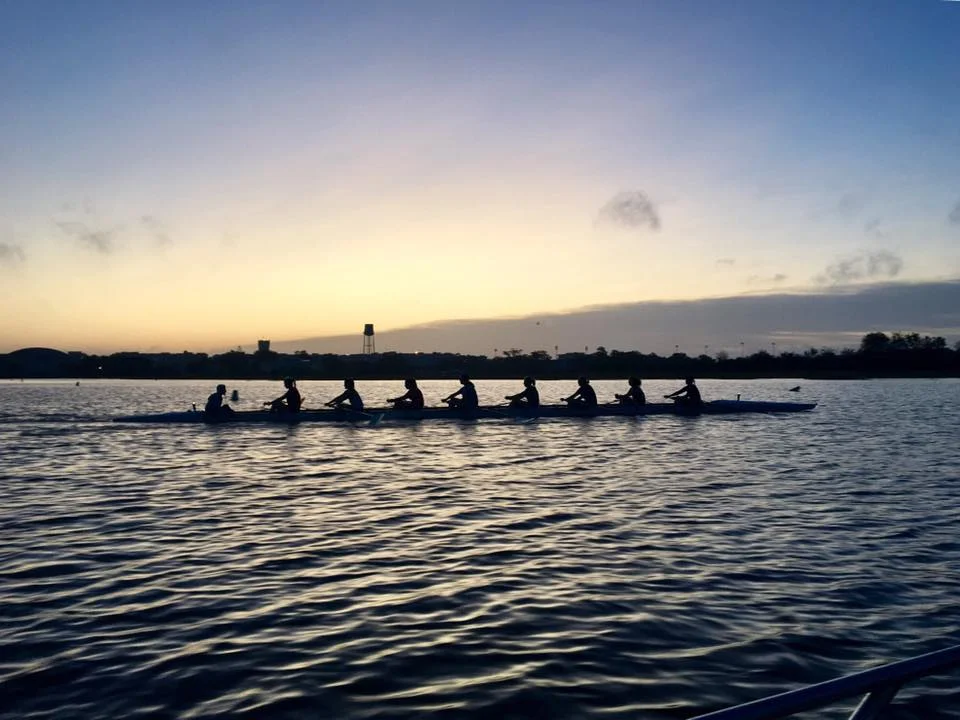
Clemson Sprints Weekend
Coverage and results from the team's trip to Clemson Sprints on Lake Hartwell.
Read More
A non-profit rowing team at the College of Charleston in Charleston, South Carolina.
Three mornings a week, the College of Charleston Crew Team slides shell after shell into the Ashley River before the Lowcountry fog lifts. The boats, the coxswains, the rhythm of the oars—it's the side of the club that most outsiders ever glimpse. Behind the team launch, there's a quieter tradition taking root: a food drive that has become one of the busiest stretches of the year for the student officers.
Founded as a small club paddling out of the Charleston Maritime Center, CofC Crew now carries students to head races from Cooper River to Clemson, and from Augusta to the Head of the Charles. Somewhere along the way, the rowers asked a simpler question: what does a team built on sweat and self-discipline owe the city that hosts it? The answer, for several years running, has been a partnership with the Lowcountry Food Bank.
Australian readers will recognise the pattern instantly. Back home, surf lifesaving clubs, suburban footy sides, and university rowing programs have long stitched community fundraising into their calendars. Aussie rowers heading off to the NSW Head of the Yarra in Melbourne, or rolling in for the Sydney International Rowing Regatta at Penrith, tend to bring their clubs along—whether that means a Bunnings snag run on regatta weekend or a sweep through IGA shelves for OzHarvest donations.
CofC Crew traces its lineage to the early days of Carolina coastal rowing, when students cobbled together a four-person shell and a van that groaned at every highway crossing. Generations later, the club fields a women's eight, a men's eight, a novice squad, and alumni scullers who still turn up for open water rows. The boathouse routines—rigging, timing pieces, erg scores on the chalkboard—have barely shifted.
What has shifted is the calendar. A typical season now includes not just regattas and erg tests, but also a coordinated push to fill donation bins at the home boathouse. Coaches frame the food drive as off-water training. Student captains, who rotate through the role annually, treat it as a chance to test their logistics as seriously as their lactate thresholds.
The mechanics are deliberately simple. Bins sit in two residence hall lobbies, and a third lives at the boathouse. Rice, peanut butter, tinned proteins, and pasta sauce top the most-requested list. Once a month, a borrowed pickup—about the closest thing America produces to a ute—shuttles everything to the Lowcountry Food Bank's warehouse in North Charleston.
Student officers take turns loading, weighing, and sorting. A rower who spends three hours bent over canned beans on a Sunday afternoon learns something no erg session teaches: the team's identity extends past the buoy line. It's a small dose of perspective that lingers longer than any morning erg.
A growing body of research, much of it run out of Australian universities like La Trobe and the University of Queensland, suggests that athletes who volunteer tend to stick with their sport longer. The pattern holds whether you're part of a Sydney soccer club or a coastal rowing program in South Carolina. Discipline is a muscle, and using it away from competition reinforces its strength on the water.
CofC Crew's coaches have noticed this in practice. Newcomers who help unload the food collection often return the following semester, even when their two-k splits never really arrive. The team retains people through meaning as much as medals.
Charleston's hunger picture is gentler in some neighbourhoods than in others. The food drive routes donations into a network of pantries, after-school programs, and mobile markets serving families from West Ashley to Johns Island. The Lowcountry Food Bank has been vocal about which items matter most, and the rowers have listened.
A practical ripple effect: businesses near the Charleston Maritime Center now flag donation windows in their staff newsletters. Local restaurants occasionally match what the athletes collect. It's a small example of compounding goodwill, the kind that takes root when an institution shows up repeatedly rather than once.
Australia has its own tradition of sport-as-service. The AFL's annual community round, casual footy sausage sizzles, and surf club donation drives along the eastern seaboard have carried charitable weight for years. Rowing, traditionally more genteel, has been catching up. Clubs around Albert Park Lake in Melbourne routinely run food appeals at their senior regattas, often with Foodbank Australia.
The CofC food drive sits comfortably in that conversation. Set in a port city whose skyline once shipped rice and indigo overseas, it asks people who are fit, organised, and used to early starts to do one more thing—something closer to the long, communal fundraising Australians recognise in a Saturday morning regatta.
For students at the College of Charleston, signing up means showing up at a team meeting and adding your name to the roster. Alumni and parents often ask how they can contribute; the team's news page lists drop-off times, most-needed items, and upcoming regattas each season. Donors should check the wish list, not guess, because the food bank distributes exactly what it receives.
If you're new to Charleston and to rowing, the team welcomes beginners who come for the cause as much as the sport. Reach out through the crew's contact channels and you'll likely find a novice seat by the following semester.
Pitching in doesn't require a rowing seat. The most useful contributions are usually small, practical, and stacked so they compound across a season.
College of Charleston Crew fields competitive eights and fours in both Fall head races and Spring sprint regattas across the Southeast.
Learn MoreRecent news, recaps, and announcements from the team.
Coverage and results from the team's trip to Clemson Sprints on Lake Hartwell.
Read More
Spring lineup including Clemson Sprints, SIRA, Dad Vail, and ACRA National Championship.
Read More
Previews and recap of past Head of the Charles appearances, including the 50th annual regatta in 2014.
Read MoreTeam practice, regatta dates, and meetings are listed on the team calendar. Coaches post weekly schedules and travel details for upcoming race weekends.
Charleston Crew / CCAA
PO Box 12941
Charleston, SC 29422
Email: info@cofccrew.org
Phone: 843.513.5900
Phone: 843.276.4241
Interested in joining the team? Fill out the recruitment form and the coaches will follow up.