Clemson Sprints Weekend
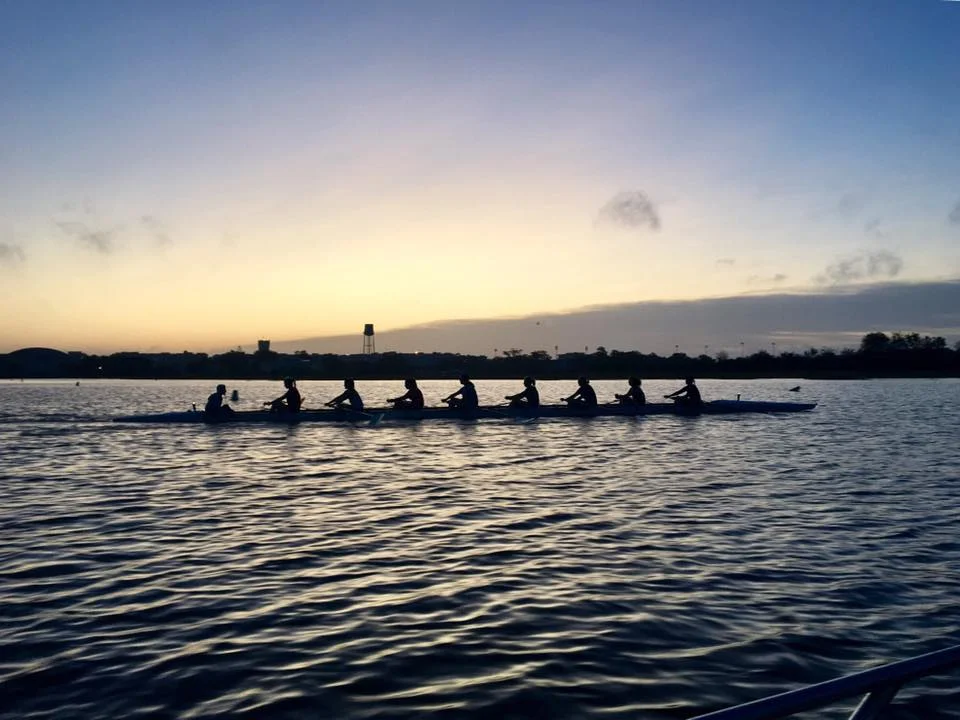
Coverage and results from the team's trip to Clemson Sprints on Lake Hartwell.
Read More
A non-profit rowing team at the College of Charleston in Charleston, South Carolina.
The morning the coxswain called our finish, I remember looking at the scoreboard and feeling the boat tilt beneath me. There was no wind across the Ashley River that Saturday, only the still air of early spring in Charleston and the hum of our oars falling out of sync. We had trained for fourteen weeks, eaten together, suffered together, and still the lane belonged to someone else.
Australian rowers recognise this feeling across the Tasman. On Sydney Harbour at dawn, crews from the Sydney Rowing Club push off knowing that some mornings the boat simply will not answer. The same holds true in Melbourne along the Yarra, where winter mornings begin with frost on the boat racks and breath fogging over blades. Sport in Brisbane carries the same weight, particularly in clubs that have measured seasons in metres gained and lost.
At the College of Charleston Crew Team, every novice eventually meets that first loss. For me, it arrived at a regatta outside Savannah, where a heavier varsity eight edged us out by barely a length. The result sat heavy for days, and the lesson took even longer to unpack. What I learned has stayed with me far longer than any trophy.
When we crossed the line second, no one spoke. The eight of us sat in the boat, oars shipped, water dripping off the blades into the river. Our coxswain unclipped her stopwatch and stared at it as if she could reverse the numbers. I remember the volunteers at the launch dock handing us water bottles without asking what had gone wrong, a kindness that still embarrasses me.
Australian training partners often speak about "sitting with the loss" rather than rushing past it. Coaches at programs across Adelaide and Perth tell their rowers to walk the dock after a bad race, to feel the wood under their feet, and to let the disappointment land before reaching for solutions. The lesson is simple and hard: grief is part of the sport, and pretending otherwise only delays the recovery.
The body keeps score long after the mind moves on. My hands ached for two days, my lats burned on the erg, and my shoulders carried tension that showed up in the strangest places. A loss lives in the muscles as much as the memory.
A finish time tells you almost nothing about what really happened in a race. The crew that beat us had four returning seniors, two of whom had rowed at the Australian equivalent of nationals during high school. We had one sophomore in the bow seat and a novice who had learned to scull only nine months earlier. Comparing our lane to theirs was never the point.
| What a win reveals | What a loss reveals |
|---|---|
| A crew that peaked on the day | A crew still learning its rhythm |
| Confidence built on result | Confidence tested by result |
| Quick confirmation of training | A map of every weakness to fix |
| External validation | Internal motivation |
| The team's ceiling on that day | The team's floor, and how to rise |
Looking at the table now, the right column has done more for my rowing than the left ever could. Losses force a rower to examine the small things, the catches that slipped, the finishes that drifted, the calls the coxswain made under pressure. A win rewards a snapshot; a loss hands you a blueprint.
For our program, those blueprints are how we plan the next season. The meet the coaches interview captures how our leadership uses these moments to shape training blocks and motivate returners.
The week after the regatta, I could not stop replaying the start. I heard the coxswain's voice, the splash of the other boat pulling ahead, the silence that followed. Australian sports psychologists often talk about rumination loops, and I lived inside one. Sleep came late. Food tasted like nothing. The erg monitor stared back at me with numbers that meant less than they should have.
Mindset work matters as much as metres of steady state. Our coaching staff introduced breathing drills, visualisation exercises, and journal prompts that helped rowers name what they were carrying. There is no Australian rowing tradition that handles this better than another, but the willingness to ask for help has become a quiet strength across clubs from Hobart to Darwin.
Slowly, the loop unwound. I returned to the boathouse not because I wanted to win, but because the rhythm of the sport had called me back. The first hard piece felt awful. The second felt almost normal. By the third, something had shifted.
A loss can splinter a boat or weld it together. Our eight chose the second path, though not without difficult conversations. We gathered at a coffee shop on King Street, ordered too many flat whites, and talked until the baristas began stacking chairs around us. There is something powerful about naming what went wrong out loud, especially when every voice gets heard.
Australian club culture mirrors this approach. Mateship, the quiet value that holds crews together, means showing up after the bad race, not just the good one. The tradition of rolling up the sleeves after a defeat, sometimes literally with the rigging, has deep roots in places like the Murray River rowing communities and the small clubs along the Victorian coast.
By the end of the week, our boat had a new playlist, a new warm-up routine, and a renewed promise to each other. The loss had not broken us. It had revealed what we were willing to do for one another.
Months later, the same novice who learned to row only a year ago stroked a four to a third-place finish at a regional regatta. None of us forgot the first one. We carry it into every race plan, every technical session, every conversation about what it means to compete. A loss done well becomes a quiet teacher that travels with you for the rest of your life.
For anyone considering joining a collegiate program, the College of Charleston Crew Team is a place where first losses turn into first comebacks. Beginners and experienced rowers alike find a home here, a community shaped as much by hard days as by fast finishes.
College of Charleston Crew fields competitive eights and fours in both Fall head races and Spring sprint regattas across the Southeast.
Learn MoreRecent news, recaps, and announcements from the team.
Coverage and results from the team's trip to Clemson Sprints on Lake Hartwell.
Read More
Spring lineup including Clemson Sprints, SIRA, Dad Vail, and ACRA National Championship.
Read More
Previews and recap of past Head of the Charles appearances, including the 50th annual regatta in 2014.
Read MoreTeam practice, regatta dates, and meetings are listed on the team calendar. Coaches post weekly schedules and travel details for upcoming race weekends.
Charleston Crew / CCAA
PO Box 12941
Charleston, SC 29422
Email: info@cofccrew.org
Phone: 843.513.5900
Phone: 843.276.4241
Interested in joining the team? Fill out the recruitment form and the coaches will follow up.