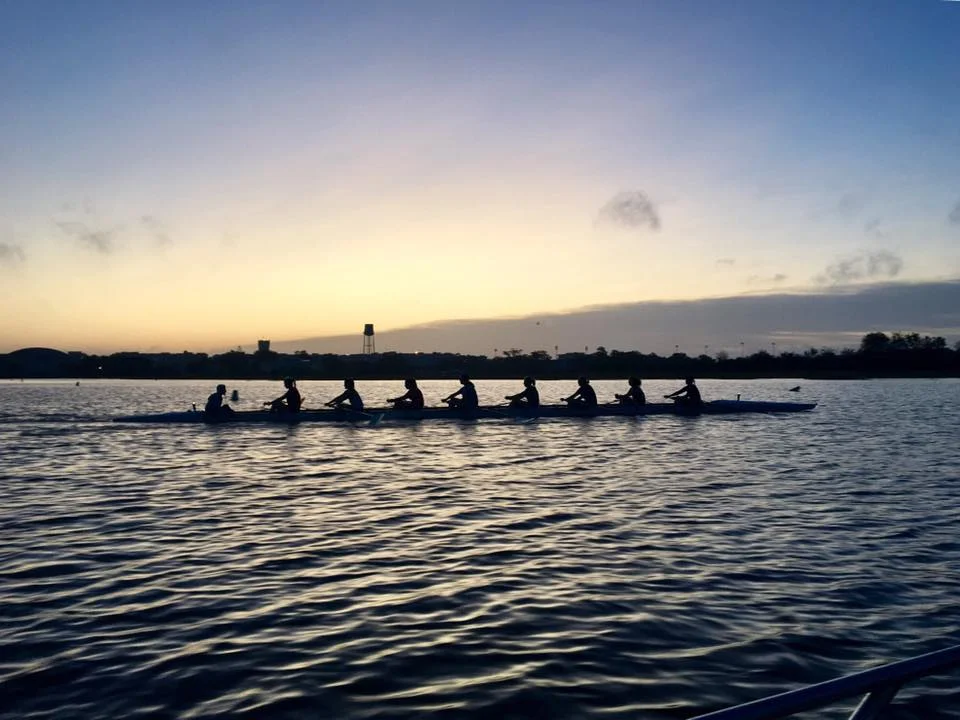
Clemson Sprints Weekend
Coverage and results from the team's trip to Clemson Sprints on Lake Hartwell.
Read More
A non-profit rowing team at the College of Charleston in Charleston, South Carolina.
The Atlantic bottlenose is a familiar sight to anyone who has spent time on the waterways around Charleston, South Carolina. These intelligent marine mammals thrive in the estuarine environment of Charleston Harbor, where the Ashley and Cooper rivers meet the open sea. For the College of Charleston Crew Team, sharing the water with dolphins is not an occasional novelty but a daily part of practice. New rowers quickly learn that an eight-person shell moving across the harbour draws the attention of curious pods almost as reliably as a fishing trawler would. Learn more about Cofccrew.org.
Wildlife encounters add a layer of magic to the repetitive work of sweep rowing and sculling. There is something humbling about catching a glimpse of a dorsal fin slicing through the water between strokes, or watching a mother and calf arc gracefully along the marsh grass while the coxswain calls the rate. The team has logged countless moments when practice suddenly became unforgettable, simply because a pod decided to join the session. Coaches often point to these experiences as one of the underrated benefits of training on tidal saltwater rather than a placid lake.
The crew programme welcomes athletes at every skill level, from rowers who arrived at college with years of competitive experience to those who touched an oar for the first time during orientation week. Beginners quickly discover that the wildlife is not background scenery; it actively shapes each outing. Dolphins bow-riding, pelicans diving for breakfast, and the occasional sea turtle surfacing for air all become reference points that help novices understand boat speed, wake behaviour, and water reading. The Charleston harbour functions as both classroom and theatre.
Charleston Harbour supports one of the densest populations of Atlantic bottlenose dolphins on the eastern seaboard. Researchers from the nearby marine research centres have tracked resident pods that use the harbour year-round, feeding on the abundant fish stocks drawn to the saltmarsh estuaries. The harbour's geometry, with its network of tidal creeks, oyster beds, and grass flats, creates ideal hunting grounds. Dolphins frequently travel in small family groups of three to seven individuals, working the currents in coordinated fashion.
Rowers on the College of Charleston team share these waters with both resident and transient dolphins. Resident pods tend to stay closer to the inlets and creek mouths, while transients pass through on their way up or down the coast. The team practices in the early morning when tidal flow is strongest, and that is also when dolphins tend to be most active. Sightings are so reliable that coaches have stopped treating them as events. A practice without at least one dolphin encounter is considered unusual.
The harbour is more than a dolphin habitat. Egrets and herons stalk the marsh edges, ospreys nest on channel markers, and loggerhead turtles drift past in late summer. Manatees occasionally wander up the intracoastal during warm spells, surprising even seasoned rowers. This biodiversity is a quiet reminder that the team operates as a guest in a working ecosystem.
Wildlife that crews may share the water with:
Dolphins are drawn to moving vessels because of the pressure wave created by the hull. The bow pushes water outward and downward, then it snaps back behind the boat, generating a small lift zone that dolphins exploit to swim with minimal effort. A rowing shell produces a modest wake compared to a powerboat, but it still creates enough hydrodynamic lift to make bow-riding worthwhile for a pod that wants to conserve energy.
Biologists note that dolphins choose their companions selectively. A pod will often test a new vessel for several minutes before committing to ride the wake. They tend to prefer boats that move at a steady, predictable pace, which suits rowing crews perfectly. Coxswains sometimes notice that dolphins align with the bow of the fastest boat in a line, almost as if racing. Whether this is play, curiosity, or simple efficiency remains a topic of marine research, particularly at institutions along the South Carolina coast.
There is also a social dimension to these encounters. Dolphins communicate constantly with clicks and whistles, and researchers believe that close passes near humans and vessels may be a form of shared exploration rather than mere opportunism. For rowers, the practical takeaway is simple: keep the line clean, hold the rate steady, and let the dolphins decide how long they want to stay. Chasing or altering course to follow them disrupts their behaviour and risks collision.
Marine wildlife guidelines in South Carolina mirror those promoted by rowing associations worldwide. Maintain a distance of at least fifty metres from dolphins, never feed them, and avoid separating mothers from calves. If a pod approaches the shell, rowers should hold their line and reduce the rate briefly to avoid creating a sudden wash. Coxswains are trained to call wildlife sightings to the crew so that no one makes an erratic blade movement that could startle an animal.
The College of Charleston Crew Team has built wildlife awareness into its novice programme. First-year rowers receive a short briefing on harbour etiquette, including how to recognise the signs of a stressed animal and what to do if a dolphin veers directly into the boat's path. The team follows the regional marine wildlife code, which emphasises passive observation over interaction. This approach aligns with the philosophy used by Australian coastal rowing clubs on Sydney Harbour and along the Brisbane River, where dolphins also routinely join training outings.
Australian rowers will recognise the pattern. Bunbury, on the coast of Western Australia, is famous for a resident dolphin population that interacts daily with visitors and watercraft. Closer to the capital cities, bottlenose pods patrol the harbour at Sydney and follow training shells around the pontoons at Darling Harbour. Brisbane rowers regularly share the river with dolphins near the university reaches, and crews paddling out from the Gold Coast often sight humpback whales during the migration season.
The parallels between Charleston and Australian rowing environments are striking. Both rely on tidal estuaries, both enjoy mild winters that allow year-round training, and both have resident dolphin populations that tolerate human presence. The difference lies in scale. Australian coastal rowers may encounter dugongs in Moreton Bay or fur seals near Hobart, while Charleston rowers more often share the water with sea turtles and the occasional manatee. The shared thread is that wildlife is woven into the rhythm of the sport rather than reserved for special excursions.
Rowing federations on both sides of the Pacific have begun formalising wildlife protocols. Head of the River regattas in New South Wales and Victoria now include briefings on cetacean etiquette, much like the pre-race notes distributed to visiting crews at southeastern regattas in the United States. The trend reflects a growing awareness that competitive rowing and conservation can coexist, provided athletes treat the water with the respect it deserves.
Signing up with the College of Charleston Crew Team means signing up for early mornings on the harbour, unpredictable weather, and the steady company of local wildlife. Prospective members can find the latest intake details and competition schedule on the CofC Crew Team website, where contact information for the coaching staff and student officers is also listed. The programme welcomes walk-ons, and no prior rowing experience is required for the novice intake each autumn.
Teams travel throughout the Southeast and up the East Coast for regattas, including the Head of the Charles in Boston and races in Florida and Virginia. Off the water, fundraising events and social media updates keep alumni and supporters connected to the programme. Whether the goal is to compete at a national level or simply to spend a few seasons gliding past dolphins at sunrise, the crew offers a path that is both athletic and deeply tied to the coastal landscape that surrounds Charleston.
Practical tips for spotting wildlife on early-morning rows:
College of Charleston Crew fields competitive eights and fours in both Fall head races and Spring sprint regattas across the Southeast.
Learn MoreRecent news, recaps, and announcements from the team.
Coverage and results from the team's trip to Clemson Sprints on Lake Hartwell.
Read More
Spring lineup including Clemson Sprints, SIRA, Dad Vail, and ACRA National Championship.
Read More
Previews and recap of past Head of the Charles appearances, including the 50th annual regatta in 2014.
Read MoreTeam practice, regatta dates, and meetings are listed on the team calendar. Coaches post weekly schedules and travel details for upcoming race weekends.
Charleston Crew / CCAA
PO Box 12941
Charleston, SC 29422
Email: info@cofccrew.org
Phone: 843.513.5900
Phone: 843.276.4241
Interested in joining the team? Fill out the recruitment form and the coaches will follow up.