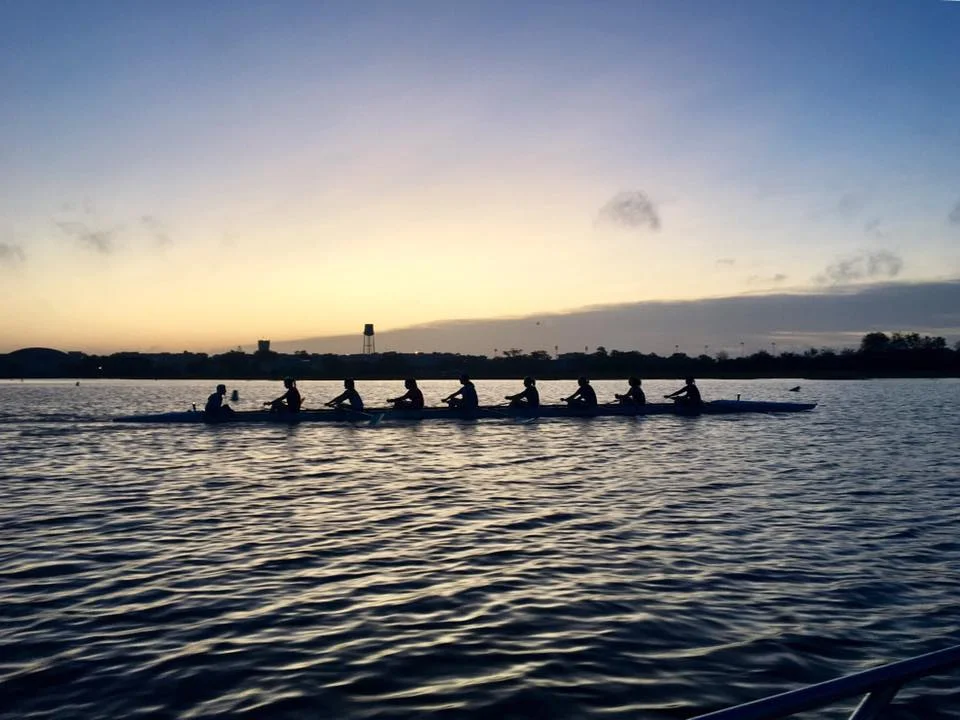
Clemson Sprints Weekend
Coverage and results from the team's trip to Clemson Sprints on Lake Hartwell.
Read More
A non-profit rowing team at the College of Charleston in Charleston, South Carolina.
A coxswain guides the boat, shapes its rhythm and keeps eight rowers working together. A call is most effective when it sounds calm, arrives at the right moment and gives the crew confidence in what happens next.
The College of Charleston crew program welcomes experienced athletes and beginners, so each command must suit people with different levels of confidence. A stern tone may suit an experienced eight; a clear, reassuring voice may be better for a novice crew learning to row in unison.
Strong communication also depends on trust. Rowers need to know that a coxswain will issue clear instructions, respond consistently to changing conditions and never ask for effort without a sound reason.
A coxswain’s voice is the boat’s central steering instrument. It explains what the crew should do, when the change should happen and how urgently the movement is required. The college rowing transition can bring new challenges in workload, expectations and terminology.
Concise calls leave room for concentration. “Length at 20, steady through the marker” provides more useful information than a long explanation delivered over the stroke. The crew hears one instruction, responds as a unit and remains focused on the next task.
Tone should match the situation. Neutral information works for routine changes, while a firmer voice signals an immediate hazard. Raising the volume for every call can make routine instructions feel alarming and leave rowers unsure which commands truly require immediate action.
Pace and articulation matter as much as volume. A coxswain should place the key word where the crew needs it: “Bow, check your line” or “Hands, through.” Short, deliberate commands cut through wind, splashing water and the noise of oarlocks.
Calls are valuable only when they arrive early enough to be useful. A steering correction at the last moment may prevent a collision, but it cannot create clean water. Coxswains should look beyond the immediate obstacle, anticipate the required movement and give the rowers time to settle into it.
Timing also changes with the race plan. During the start, the crew needs a shared rhythm; in the middle, length calls and rate changes should match the intended strategy. Anyone following latest team news can see how preparation, competition and team activity connect beyond individual training sessions.
Experienced rowers often recognise a coxswain’s preferred sequence of calls. New rowers need that sequence explained and repeated consistently. The same command should mean the same thing at every practice, regatta and team outing.
Consistency builds confidence, but trust also requires honesty. If the boat cannot maintain the requested rate, the coxswain can adjust the plan and explain why. Crew members then understand that the calls reflect conditions rather than arbitrary changes of mood.
Charleston’s harbour traffic, ferry routes and recreational craft demand constant attention. A coxswain should watch crossings, intersecting wakes and shallow areas, then give one decisive instruction. Conflicting calls such as “hold” followed immediately by “go” can disrupt balance and cost speed.
Clear coordination also extends beyond the water. Community routines such as the team’s car wash tradition depend on volunteers understanding their roles. The same principle applies aboard the shell: defined responsibilities and reliable communication reduce confusion.
Rowing in Australia offers useful parallels, particularly around Sydney Harbour, Melbourne’s Yarra and the Brisbane River. Local conditions demand confident calls, sensible preparation and respect for people sharing the waterways.
State work health and safety laws also place duties on clubs to train volunteers, assess hazards and provide suitable supervision. A coxswain’s authority on the water does not replace the club’s broader responsibility for safe equipment, competent instruction and documented risk controls.
Coxswain calls become sharper through deliberate rehearsal. A training session can focus on steering, power or rhythm, with the crew evaluating the words used to direct each phase. Coaches can then connect the call to the movement they actually want.
A coxswain earns trust when preparation, tone and timing reinforce one another. The best calls sound simple because the crew understands the boat, the conditions and the person giving the command.
College of Charleston Crew fields competitive eights and fours in both Fall head races and Spring sprint regattas across the Southeast.
Learn MoreRecent news, recaps, and announcements from the team.
Coverage and results from the team's trip to Clemson Sprints on Lake Hartwell.
Read More
Spring lineup including Clemson Sprints, SIRA, Dad Vail, and ACRA National Championship.
Read More
Previews and recap of past Head of the Charles appearances, including the 50th annual regatta in 2014.
Read MoreTeam practice, regatta dates, and meetings are listed on the team calendar. Coaches post weekly schedules and travel details for upcoming race weekends.
Charleston Crew / CCAA
PO Box 12941
Charleston, SC 29422
Email: info@cofccrew.org
Phone: 843.513.5900
Phone: 843.276.4241
Interested in joining the team? Fill out the recruitment form and the coaches will follow up.