Clemson Sprints Weekend
Coverage and results from the team's trip to Clemson Sprints on Lake Hartwell.
Read More
A non-profit rowing team at the College of Charleston in Charleston, South Carolina.
Flipping a shell is a capsize: the narrow hull rolls until its deck is underwater and the rowers are outside their seats. It can occur during a planned drill, a race start or an unexpected disturbance, so the goal is always a controlled recovery rather than a quick, improvised swim. Learn more about 5 Rowing Drills That Improve Your Stroke On The Water.
A competent response begins before anyone enters the water. College of Charleston Crew’s experienced athletes and beginners can use the same coxswain-led sequence: stay together, keep the shell visible, check injuries and return only when the boat and surrounding traffic are secure.
Most capsizes begin with wind, a wake, another boat, an unusually deep blade or uneven pressure between sides. In an eight, a small imbalance can spread quickly through the crew; in a scull, one disrupted stroke may be enough to pull the hull over. Planned drills differ because everyone knows the command and enters the water under supervision.
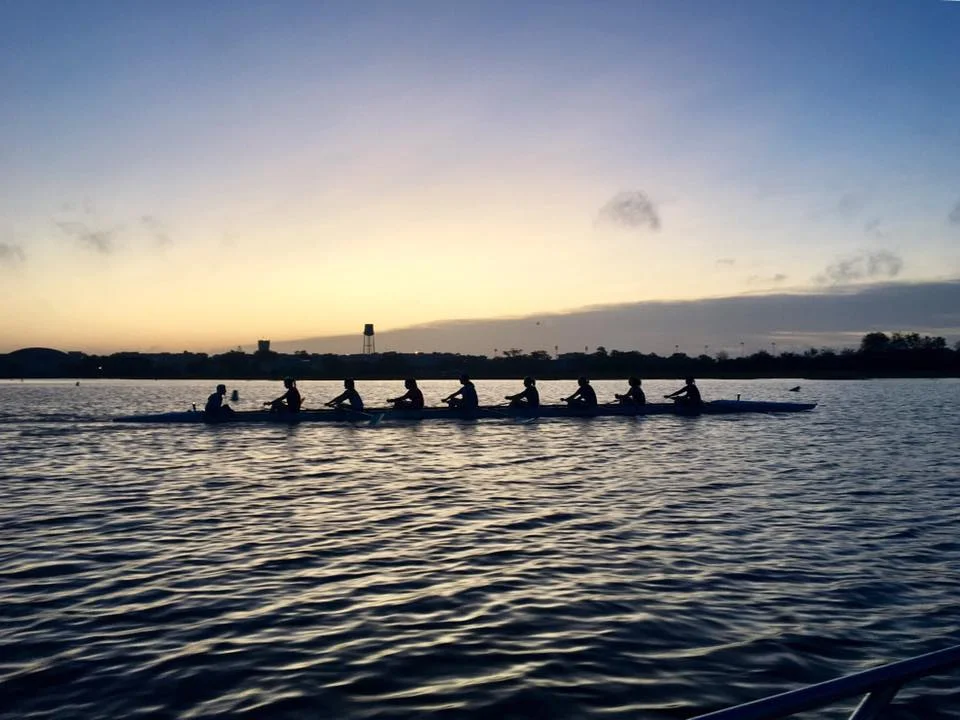
A rowing shell has a long, narrow hull and very little freeboard, making it less stable after it turns. Oars act as levers, while riggers and seats can snag clothing or trap limbs. Understanding how the crew maintains balance in these training photos can help newer rowers recognise unstable movements before they become dangerous.
At the capsize, follow the coxswain or nearest coach. Protect your head from oar handles and riggers, remain beside the shell unless injury or traffic requires urgent escape, and keep the boat visible to rescuers. Stay clear of the oarlocks because sweep blades can move forcefully beneath the surface.
Report pain, numbness or an inability to move an injured limb immediately. An approved personal flotation device should be worn where waterway rules or club policy require it, with the cox confirming compliance before launch. Rowers should never disappear underneath the hull or attempt a solo return to shore while the boat is still within reach.
Once the cox declares the area safe, the team rights and stabilises the shell using its practiced technique. Do not force a trapped foot, shoulder or hand; support the body, hold position and summon the coach. Re-entry methods differ between sweep boats and sculls, so rowers should wait for coxswain instructions rather than rushing at once.
A capsize interrupts balance, timing and confidence, even when nobody is hurt. Preparation should include swimming fitness, communication and controlled practice on the water. The five water drills listed in this stroke guide can help crews improve boat control before a heavier shell or rougher venue creates greater risk.
Club safety equipment should include first-aid supplies, a charged phone in a dry bag, a whistle, throw lines and suitable flotation devices. Local chandlers and Australian marine retailers stock compact PFDs, tow lines and marine-grade safety equipment suitable for club storage. Flotation remains essential even when oar blades are buoyant and may float away from the hull.
Australian conditions require specific checks before launch. Sydney Harbour sessions need close attention to tide and commercial traffic, Melbourne’s Yarra can produce narrow-channel congestion and strong currents, and Hobart’s Derwent water can be dangerously cold. Many Australian rowing clubs use a cox-led, bow-number head count and team debrief after every capsize, turning a stressful incident into a clear record of what happened.
The immediate response depends on whether the shell is empty, drifting near traffic or connected to an injured rower. Equipment matters only after people are secure, and a planned recovery should never continue when emergency assistance is required.
The cox should assess conditions before directing anyone back aboard. Nearby support boats can control traffic, while shore-based assistance may be more appropriate if the shell has moved into a hazardous channel.
| Situation | Immediate response | Required next step |
|---|---|---|
| Shell is empty and stable | Remain beside the hull and signal that help is needed | Cox checks the boat and directs re-entry |
| Shell is drifting near traffic | Alert nearby craft and keep clear of moving looms | Qualified boat support recovers the hull |
| Foot or shoulder is trapped | Support the limb without forcing it free | Coach or rescue boat frees the rower safely |
| Head, chest or breathing injury occurs | Alert others and seek emergency assistance | Call 000 and follow the club rescue plan |
Any loss of consciousness, confusion, chest pain or breathing difficulty after a capsize needs urgent medical assessment. In Australia, 000 should be called when symptoms are serious or immediate assistance is required. Once emergency services are involved, the cox records the crew’s locations and circumstances while the shell and equipment remain secondary to personal safety.
College of Charleston Crew fields competitive eights and fours in both Fall head races and Spring sprint regattas across the Southeast.
Learn MoreRecent news, recaps, and announcements from the team.
Coverage and results from the team's trip to Clemson Sprints on Lake Hartwell.
Read More
Spring lineup including Clemson Sprints, SIRA, Dad Vail, and ACRA National Championship.
Read More
Previews and recap of past Head of the Charles appearances, including the 50th annual regatta in 2014.
Read MoreTeam practice, regatta dates, and meetings are listed on the team calendar. Coaches post weekly schedules and travel details for upcoming race weekends.
Charleston Crew / CCAA
PO Box 12941
Charleston, SC 29422
Email: info@cofccrew.org
Phone: 843.513.5900
Phone: 843.276.4241
Interested in joining the team? Fill out the recruitment form and the coaches will follow up.