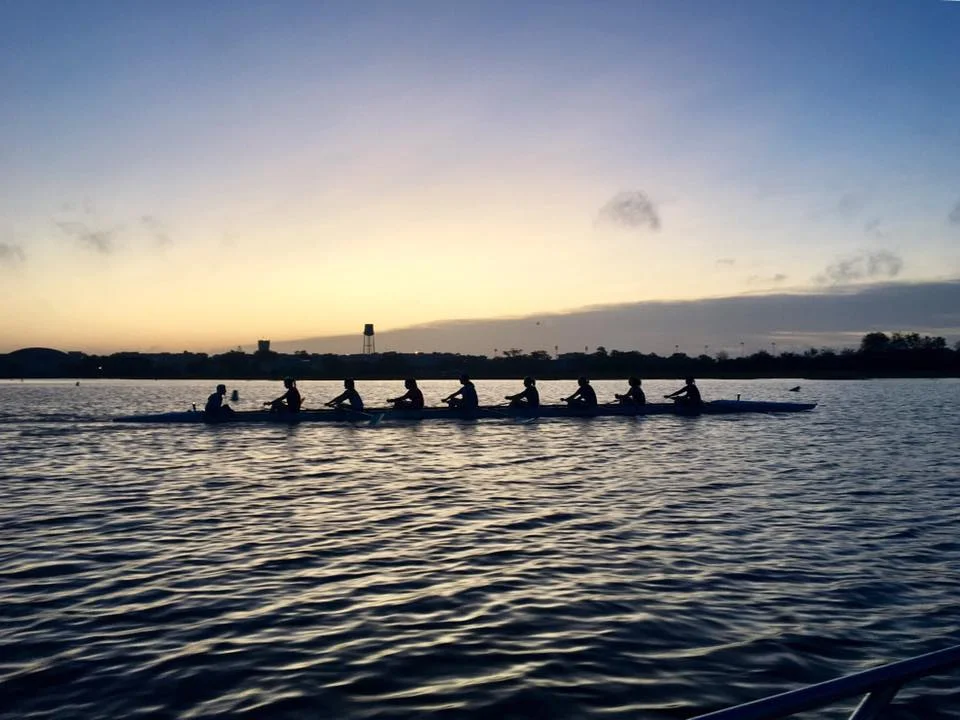
Clemson Sprints Weekend
Coverage and results from the team's trip to Clemson Sprints on Lake Hartwell.
Read More
A non-profit rowing team at the College of Charleston in Charleston, South Carolina.
A well-set foot stretcher gives every stroke a stronger mechanical base. It positions the feet so the rower can lengthen the legs without losing alignment at the catch, then transfers that force through the seat and handle. Small changes to footplate angle, heel-cup placement or strap tension can affect speed, comfort and power over hundreds of metres.
Settings are not universal. The boat, seat position, shoes and rower’s anatomy all matter, so a setup that feels right in one shell may be wrong in another. For Australian rowers, whose club fleets may include older boats alongside newer racing shells, treat the stretcher as a boat-specific fitting rather than a setting to copy. A coach’s eye and a few measured strokes should make the final call.
The foot stretcher is the fixed connection between the rower and the boat. Its footplate, heel cup and instep strap keep each foot from sliding as the knees compress and extend. When those parts are aligned, the legs can contribute through a long, smooth drive instead of breaking the stroke early.
The useful reference point is the catch. With the handle approaching the shins, the shins should be close to upright, the heels should rise only within a comfortable range, and the knees should compress without being forced tightly against the chest. At the finish, the heels should settle and the ankles should move naturally. A heel that jumps dramatically or a knee that drifts inward signals that the setup needs attention.
Do not confuse a stronger stroke with a more extreme position. If the feet sit too far forward, feel cramped or angle awkwardly, the rower may generate force but lose it in the knees. Comfort, range and a stable finish usually reveal a more efficient power position.
Begin with the same thin rowing sock and flat-soled shoe used for racing. Australian sporting-goods shops commonly stock neoprene rowing shoes and low-profile trainers, so choose a flexible sole rather than a cushioned running shoe. The shoe should lie flat against the footplate without bunching; a bulky sock can move the heel forward and alter the setting.
Place the heel in the cup and bring the ball of the foot to the stop without curling the toes. The instep strap should hold the foot securely without pinching it or crossing the toes. Check that both feet sit identically, because even a small difference can make one knee open before the other.
Foot placement should be tested in the actual shell. In shared Australian club fleets, a rower might use a well-used eight at a Sydney club and a newer quad at a Melbourne regatta, and each boat has a different baseline. Record the stop position and heel-cup setting for each craft rather than relying on memory.
Before changing anything, inspect the footplates, rods, cups and straps for wear. A loose rod or flattened cup can look like a poor fit but is actually a maintenance fault. Tighten the fittings, then check that the footplates remain parallel and that the straps are the same length on both sides.
For an adjustable model, change the stretcher angle in small increments. At the catch, aim for a near-vertical shin and enough knee bend to keep the handle travelling smoothly; at the finish, the legs should be straight without the ankles being pinned. Some older boats have a fixed angle, so an experienced coach should identify the right correction instead of forcing the hardware.
Conditions also matter. Melbourne’s Yarra can bring cold winter rain and a rising current, while Sydney Harbour often combines hard sunlight with a stiff afternoon sea breeze. Grip, posture and perceived effort can change in those conditions, making a quick foot check before launch worthwhile. Charleston’s tidal Cooper River can alter the boat’s feel as the tide changes, so the best setup may need confirmation on the water.
Make one adjustment at a time and keep a simple record of the boat, foot setting and stroke rate. Start with ten controlled strokes at an easy pace, then add six to eight strokes at race intensity. Watch for a late heel lift, an early knee opening and any pull of the strap across the foot.
Use an ergometer as a useful baseline, but finish the test in the boat. The ergometer can show whether a change feels smoother; the shell reveals balance, seat travel and the actual transfer through the footplates. If the feet remain quiet and the stroke gains length without extra effort, the adjustment is probably serving the force chain.
College of Charleston students who balance crew with fraternity or sorority commitments can protect training quality by treating setup checks as preparation rather than extra administration. The team’s advice on student-athlete balance supports that approach: reliable equipment leaves more attention for the session instead of niggles at the start of every piece.
A short pre-row check takes less time than correcting a painful stroke. Sit in the shell, secure the straps, set the heels in the cups and settle the balls of the feet against the stops. Reproduce the catch position, check the shins, then make the smallest adjustment that restores alignment.
At regattas, many Australian crews move between sweeps, quads and borrowed club equipment, so a setup card for each boat is useful. College of Charleston’s race calendar can be consulted when planning a race-day shell rotation or a practice block on the water. The habit is simple: inspect, adjust, test and record.
Keep the routine calm and consistent. A coach-checked baseline, the right rowing shoe and a quick confirmation after moving boats turn the foot stretcher from guesswork into a dependable source of power. When the feet are quiet, the knees track together and the drive reaches the handle, the boat feels lighter because more of the rower’s effort is going in one direction.
College of Charleston Crew fields competitive eights and fours in both Fall head races and Spring sprint regattas across the Southeast.
Learn MoreRecent news, recaps, and announcements from the team.
Coverage and results from the team's trip to Clemson Sprints on Lake Hartwell.
Read More
Spring lineup including Clemson Sprints, SIRA, Dad Vail, and ACRA National Championship.
Read More
Previews and recap of past Head of the Charles appearances, including the 50th annual regatta in 2014.
Read MoreTeam practice, regatta dates, and meetings are listed on the team calendar. Coaches post weekly schedules and travel details for upcoming race weekends.
Charleston Crew / CCAA
PO Box 12941
Charleston, SC 29422
Email: info@cofccrew.org
Phone: 843.513.5900
Phone: 843.276.4241
Interested in joining the team? Fill out the recruitment form and the coaches will follow up.