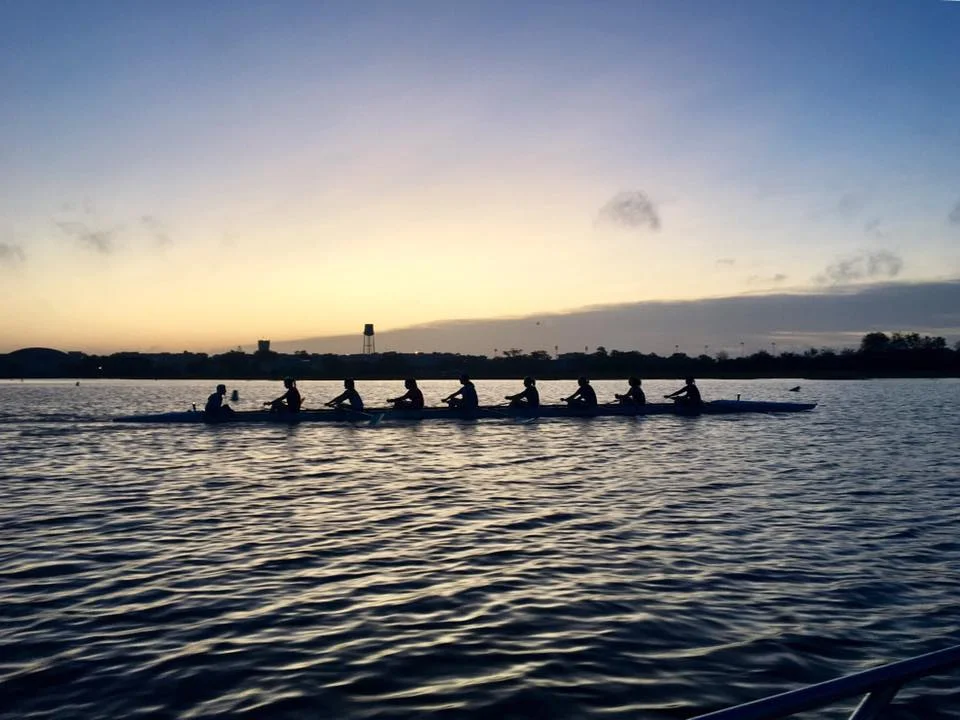
Clemson Sprints Weekend
Coverage and results from the team's trip to Clemson Sprints on Lake Hartwell.
Read More
A non-profit rowing team at the College of Charleston in Charleston, South Carolina.
At a regatta, two boats can look equally sleek while requiring different skills. Sweep rowing gives each athlete one oar; sculling gives each athlete two. That simple equipment choice shapes balance, coordination and race strategy.
The College of Charleston Crew Team is a collegiate club program based in Charleston, South Carolina. It welcomes experienced rowers and beginners, with competition across the Southeast and along the U.S. East Coast.
For Australian spectators, Sydney Harbour’s Head of the River, Melbourne’s Yarra regattas and Perth’s Swan River events offer familiar benchmarks. Australian club culture also includes shared shed mornings, sausage-sizzle fundraisers and second-hand gear markets, where racing tradition meets everyday equipment.
Understanding the difference between sweep rowing and sculling helps decode results, coaching choices and why athletes may change boat types during a season.
In a sweep boat, each rower pulls one oar. Pairs, fours and eights use the same principle, although larger crews distribute the work and absorb changing water conditions. The stroke still relies on every blade entering and leaving the water together.
Sculling gives each rower two shorter oars, usually on opposite sides of the shell. Pairs, fours and eights can all scull. Without relying on a coxswain to direct the boat, the sculler controls both blades, making individual balance and coordination especially important.
Boat choice follows the handling demands. Sweep shells are typically beamier and fitted with longer, heavier oars; scull shells are narrower and use shorter oars. Both may use carbon-fibre construction, so material alone does not determine style.
The clearest crew-role contrast is steering. A sweep eight is normally led by a coxswain seated at the bow or stern, calling the stroke and boat direction. Sweep fours and pairs may be coxed or coxless. Competitive sculling is generally coxless because the rowers must steer themselves.
Sweep rowing rewards a strong, unified rhythm. Each athlete must match drive, recovery and blade angle while the long oar generates considerable leverage. Small timing errors become visible as the shell swings.
Training exposes different weaknesses. Scullers need equal pressure and smooth feathering on both sides, whereas sweepers need power, rhythm and precise calls. A College of Charleston rower’s weekly 2k preparation shows how structured training can sharpen these qualities.
Beginners usually gain more from learning the shell’s handling before chasing speed. A collegiate program can expose athletes to both boat types, then match technique to strengths. Some enjoy the teamwork of sweep; others prefer sculling’s independent blade control.
The profile balancing classes and regattas illustrates the broader commitment behind that choice: developing a student-athlete while fitting demanding practices around university life, travel and competition.
Race shorthand makes the contrast quick. A sweep event is marked with no x, such as 8+, 4+ or 2-; a sculling event carries x, such as 8x, 4x, 2x or 1x. The plus sign identifies a coxed boat.
Sweep eights often excel in larger fields because of their power and steering support, while sculling can offer tactical flexibility. To plan viewing or attendance, check the College of Charleston Crew Team’s full regatta schedule for venues, dates and event entries.
Neither style is automatically easier or faster. The best comparison considers an athlete’s skills, the boat available and the event goal.
| Feature | Sweep rowing | Sculling |
|---|---|---|
| Oars per rower | One longer oar | Two shorter oars |
| Boat shape | Generally beamier shell | Generally narrower shell |
| Steering | Often coxed at higher levels | Usually coxless |
| Technical focus | Shared rhythm, power and timing | Balance and equal blade work |
| Event codes | 8+, 4+, 2- | 8x, 4x, 2x, 1x |
For a new rower, these choices make the comparison practical:
Both boats reward the same foundations: strong legs, a stable core, coordination and trust.
College of Charleston Crew fields competitive eights and fours in both Fall head races and Spring sprint regattas across the Southeast.
Learn MoreRecent news, recaps, and announcements from the team.
Coverage and results from the team's trip to Clemson Sprints on Lake Hartwell.
Read More
Spring lineup including Clemson Sprints, SIRA, Dad Vail, and ACRA National Championship.
Read More
Previews and recap of past Head of the Charles appearances, including the 50th annual regatta in 2014.
Read MoreTeam practice, regatta dates, and meetings are listed on the team calendar. Coaches post weekly schedules and travel details for upcoming race weekends.
Charleston Crew / CCAA
PO Box 12941
Charleston, SC 29422
Email: info@cofccrew.org
Phone: 843.513.5900
Phone: 843.276.4241
Interested in joining the team? Fill out the recruitment form and the coaches will follow up.