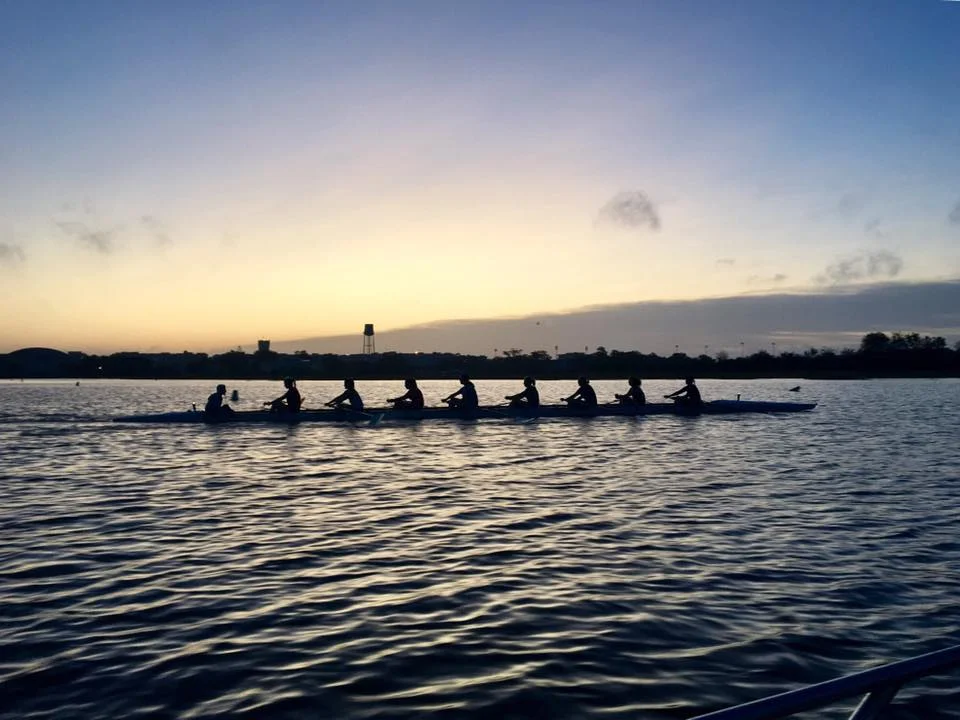
Clemson Sprints Weekend
Coverage and results from the team's trip to Clemson Sprints on Lake Hartwell.
Read More
A non-profit rowing team at the College of Charleston in Charleston, South Carolina.
For decades, rowing clubs have required athletes to demonstrate basic water competence before stepping into a shell. The College of Charleston Crew Team continues that tradition, asking every novice and veteran to pass a swim test before they are allowed on the water. For students arriving from across the United States and around the world, the requirement often comes as a surprise, yet it sits at the heart of how the program keeps its athletes safe on the Cooper River.
Charleston itself is a port city defined by its waterways, and the team's home on the Cooper brings a mixture of fresh river flow, brackish tide, and sudden weather shifts. Sweep rowers and scullers alike share the river with cargo vessels, shrimp boats, and the occasional dolphin, which makes confidence in the water non-negotiable. The swim test exists because capsizing is a real possibility, even with the best coaching and the steadiest coxswain.
Rowing programs in other parts of the world treat the swim check just as seriously. In Australia, surf lifesaving clubs run the nippers program for children as young as five, building a culture in which swimming, treading water, and recognising currents are second nature. The same instincts shape the way Sydney Harbour and the Yarra River are rowed, where crews from Sydney Rowing Club and Melbourne University Boat Club expect every new recruit to be water-ready.
Anyone considering joining the CofC crew should plan to clear the swim test early in their first semester. The rest of this article walks through what the assessment actually involves, why the program keeps the standard, how Australian rowing culture approaches the same challenge, and what a prospective rower can do to prepare.
The assessment takes place in a campus pool during the first weeks of the fall semester. Candidates swim 100 metres without stopping, then tread water for five minutes fully clothed in athletic wear, and finally demonstrate a controlled entry into the water from a low dock platform. Coaches time the swim, watch for controlled breathing, and ask each athlete to put on a personal flotation device while still in the pool.
These three skills map directly to the most common emergencies a rower might face. A swimmer who can cover 100 metres is unlikely to panic if the boat drifts away from them after a capsize, while treading water in clothing simulates the experience of being unexpectedly in the Cooper when fully dressed. The PFD drill reflects the fact that the team trains within sight of commercial traffic, where regulations around life jackets are taken as seriously as they are along Sydney Harbour and the Brisbane River.
Capsizing is rare in calm conditions, but it does happen. Equipment failure, a missed stroke at the catch, or a sudden gust over the river can flip a four or an eight in seconds. When that occurs, the crew must be able to stay together, keep their heads above water, and swim to the nearest stable object until the launch arrives.
Coaches reinforce this by rehearsing capsize drills once a season, and the swim test acts as a baseline rather than a one-off hurdle. Even rowers who joined the team as walk-ons are asked to re-certify if they have not been on the water for more than a month. The rule is simple: if you cannot swim, you do not row, regardless of your ergometer score.
The Cooper is a tidal river that can shift from glass-flat to choppy within an hour as the tide turns beneath the Ravenel Bridge. Wind funnels between the steeples of downtown Charleston and picks up speed as it crosses the open stretches near the Navy Yard, creating exactly the kind of cross-chop that unsettles new rowers. The team's stroke seat rhythm depends on every crew member being physically present, focused, and accountable from the first stroke to the last, and that shared standard begins in the pool.
Adding to the challenge, the Cooper is home to patches of grass and oyster shell near the banks, and currents pull toward the harbour inlet. A swimmer who can manage themselves confidently in those conditions becomes a crew member who can manage a boat, and the swim test filters out anyone who would be a liability in that environment.
Australian rowers grow up surrounded by water-safety education in a way few other countries match. Surf lifesaving clubs in New South Wales and Victoria run swim tests of their own, and the national body sets minimum standards that include distance swims, survival floats, and timed PFD drills. State maritime authorities, including Transport for NSW and Safe Transport Victoria, also require lifejackets on smaller craft, shaping a culture where the CofC requirement feels familiar to anyone who has spent time around Sydney Harbour, the Yarra, or the Brisbane River.
For international students arriving from Australia, the College of Charleston test is rarely a hurdle. For American students who have not spent much time in open water, it can be the first time they appreciate how seriously competitive crews treat basic swimming. The shared expectation is a small but meaningful point of connection between two rowing communities that take the water seriously.
Preparation is straightforward, and a few weeks of focused pool time is usually enough to clear every component on the first attempt.
Passing the swim test is the gateway to on-water training, and the next steps are easier than most newcomers expect. The team offers loaner oars, indoor rowing machines, and a structured beginner schedule that starts on the erg and moves quickly to stable coxed fours. New members are paired with experienced rowers who act as mentors through the first month on the water.
College of Charleston Crew fields competitive eights and fours in both Fall head races and Spring sprint regattas across the Southeast.
Learn MoreRecent news, recaps, and announcements from the team.
Coverage and results from the team's trip to Clemson Sprints on Lake Hartwell.
Read More
Spring lineup including Clemson Sprints, SIRA, Dad Vail, and ACRA National Championship.
Read More
Previews and recap of past Head of the Charles appearances, including the 50th annual regatta in 2014.
Read MoreTeam practice, regatta dates, and meetings are listed on the team calendar. Coaches post weekly schedules and travel details for upcoming race weekends.
Charleston Crew / CCAA
PO Box 12941
Charleston, SC 29422
Email: info@cofccrew.org
Phone: 843.513.5900
Phone: 843.276.4241
Interested in joining the team? Fill out the recruitment form and the coaches will follow up.