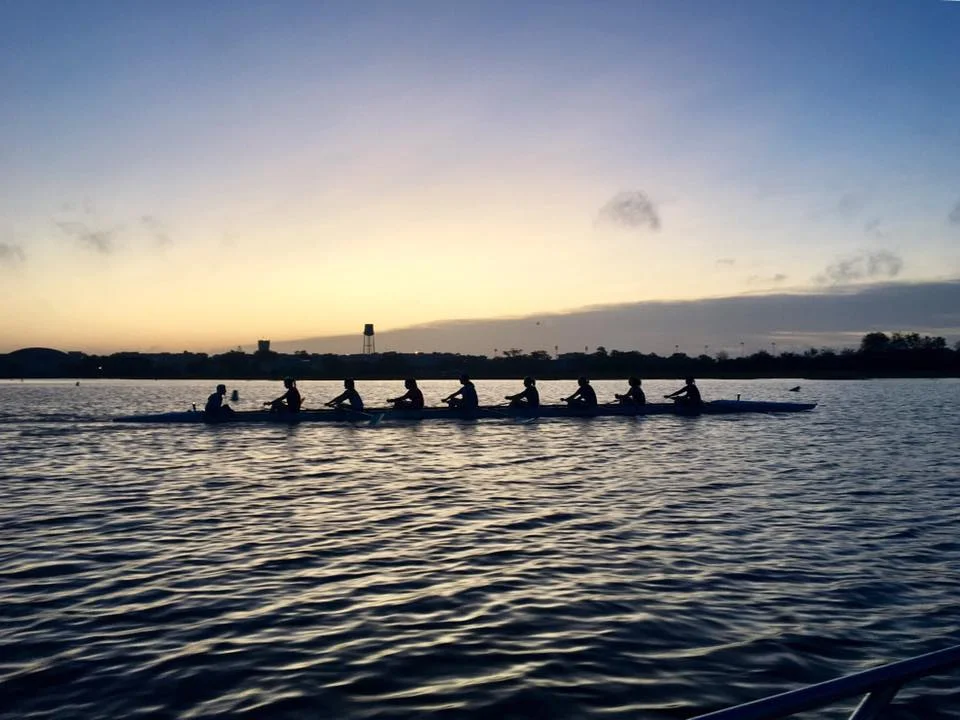
Clemson Sprints Weekend
Coverage and results from the team's trip to Clemson Sprints on Lake Hartwell.
Read More
A non-profit rowing team at the College of Charleston in Charleston, South Carolina.
Rowing-specific strength is not about making gym sessions the centre of training. It is about building a body that can drive through the catch, control the trunk and finish the pull with consistent power.
The College of Charleston Crew welcomes beginners and experienced athletes, so the best exercises must be teachable as well as productive. Beginners should learn sound technique before chasing heavier weights; stronger rowers can use load to develop useful capacity.
The advice suits Australian crews training on Melbourne’s Yarra, Brisbane’s river or Sydney’s Pittwater. Local gyms usually use kilogram plates and rubber-coated dumbbells, and indoor rowing machines are common for rehearsing race pieces.
Rowing rewards a chain of strong movements rather than one dominant muscle. Legs drive the boat, the trunk resists collapsing under load, and the lats and arms connect the pull. Strength training can improve those qualities when exercises match the demands of the stroke.
For a beginner, the crew’s advice on getting fit to row is a sensible foundation before adding demanding gym work. Learn each lift with controlled range and breathing, then increase load gradually. The aim is repeatable technique, not soreness that disrupts the next rowing session.
The deadlift is the foundation of a useful strength programme because it trains the hips, hamstrings, glutes and back as a unit. A controlled start, braced trunk and smooth extension matter more than maximal weight.
Romanian deadlifts add a hip-hinge emphasis that supports the rower’s forward swing. Keep the movement slower than a powerlifting deadlift, stop when the hamstrings reach their comfortable range, and avoid rounding the back.
The squat develops the quadriceps and glutes that initiate leg drive at the catch. Start with a goblet squat or light barbell squat, sit between the hips with the chest lifted, and drive evenly through both feet.
Split squats and step-ups add single-leg strength and control, useful when each side contributes differently to the boat. Beginners can hold a rail for balance; advanced rowers can add load. Knee pain is a reason to adjust the exercise and seek guidance, not to push through pain.
A rower needs trunk strength that resists bending and twisting, not an endless series of sit-ups. A front plank trains the body to stay braced while the legs and arms pull in opposite directions.
Pallof presses add anti-rotation work from a cable or band, while side planks train lateral control. These exercises should feel like firm tension rather than exhaustion; short, technically clean sets preserve the same posture needed on the water.
For a rowing-specific programme, pulling exercises deserve more attention than chest-heavy lifting. A one-arm dumbbell row or cable row trains the upper back and lats, helping the rower connect the arm pull to the larger body movement.
Lat pulldowns are a practical alternative when a barbell row feels uncomfortable, and they are familiar in Australian commercial gyms. Keep the ribs controlled and finish the pull towards the torso. Light face pulls can balance pressing work by training the rear shoulder.
Heavier compound lifts can use two or three sets of roughly three to six repetitions, while accessory work often works best in sets of six to twelve. Stop accessories when technique deteriorates; a controlled range and clean finish count more than a heroic final repetition.
Recovery is part of the programme. The crew’s discussion of sliding-seat recovery timing shows why timing applies beyond the boat: after loading the legs and back, leave enough space for muscles to recover before the next hard effort. An experienced coach can adjust loads and volume for each athlete.
A workable pattern places two strength sessions beside several rowing sessions, leaving recovery days between hard efforts. A beginner can do full-body sessions; an experienced rower may separate lower-body and upper-body work so heavy squats and rows do not arrive together.
Progress only one variable at a time: add a little load, another repetition or one extra set. Keep technique steady, record the session and reduce volume during busy racing blocks. The College of Charleston Crew’s coaching contact is a useful route for individual questions, while the team’s fundraising and social channels can help athletes stay connected to club sessions.
A successful programme leaves rowers stronger on the water, with better technique and more energy for the next session.
College of Charleston Crew fields competitive eights and fours in both Fall head races and Spring sprint regattas across the Southeast.
Learn MoreRecent news, recaps, and announcements from the team.
Coverage and results from the team's trip to Clemson Sprints on Lake Hartwell.
Read More
Spring lineup including Clemson Sprints, SIRA, Dad Vail, and ACRA National Championship.
Read More
Previews and recap of past Head of the Charles appearances, including the 50th annual regatta in 2014.
Read MoreTeam practice, regatta dates, and meetings are listed on the team calendar. Coaches post weekly schedules and travel details for upcoming race weekends.
Charleston Crew / CCAA
PO Box 12941
Charleston, SC 29422
Email: info@cofccrew.org
Phone: 843.513.5900
Phone: 843.276.4241
Interested in joining the team? Fill out the recruitment form and the coaches will follow up.