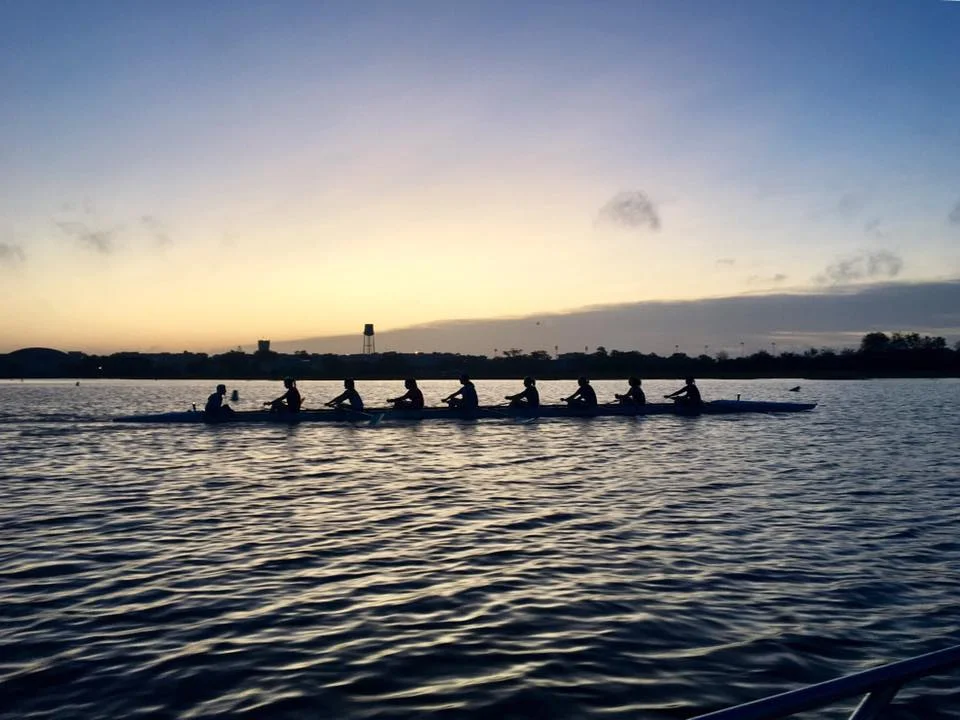
Clemson Sprints Weekend
Coverage and results from the team's trip to Clemson Sprints on Lake Hartwell.
Read More
A non-profit rowing team at the College of Charleston in Charleston, South Carolina.
College of Charleston crews often meet strong programs across the Southeast and East Coast. Reading a rival’s boat speed is about comparing motion over distance. From the bank or launch, a rower can judge acceleration, efficiency and pace without a stopwatch by separating boat movement from crew movement.
The same cues work at Australian regattas, although wind, tide and river traffic complicate them. A reliable reading comes from watching several signals at fixed points and remembering that a fast crew may be protecting energy rather than delivering maximum effort.
Boat speed means distance travelled through the water. A crew can drive hard yet remain slow if the shell barely moves between strokes. Watch forward travel, a steady glide and the shell remaining level; these usually indicate useful force.
Stroke rate is cadence, not velocity. A crew at 30 strokes per minute may labour with disturbed blades, while another at 28 may move quickly and cleanly. Count several strokes and compare crews over the same stretch.
In Australia’s second-hand shell market, club auctions and Gumtree listings produce varied fleets, with different hulls, riggers and blade sizes. A distinctive bow shape or stronger-looking splash may reflect the equipment rather than greater speed.
Begin with the first 30 to 60 seconds, when reaction and acceleration are easiest to separate. Note who responds first, whether the shell moves immediately and how quickly the crew settles into rhythm. A delayed start can make a quick crew appear slower over the opening length.
Race-day nerves can disrupt the same process. Athletes juggling early training, commuting and paid work often need a familiar routine; the program’s advice on balancing rowing and work is relevant when sleep and focus are limited.
Do not treat the start as a forecast. A crew may press early, settle into a conservative split or move inside because of lane conditions. Compare whether speed is gained or lost once each crew reaches its own rhythm.
Through the middle, cadence and splash become stronger clues. In calm water, a clean catch usually shows limited disturbance around the blades, while repeated splashing can indicate poor timing or excessive force. This is not a verdict on power: check whether the shell keeps moving while the blades enter or leave the water.
Watch wake and bow wave as secondary evidence. A narrow, persistent wake can accompany efficient travel, while a boat that surges and stops may lose time between strokes. Reflections exaggerate movement on calm water, so judge several seconds, not one flash.
Adjacent crews are easiest to compare because they share the same distance. For a distant rival, use the finish line, course markers or another shell as references, and avoid comparing crews at different points in their stride.
Position matters as much as motion. A boat half a length ahead may be faster, but it may also have started earlier or occupy a cleaner lane. Check gaps at successive markers and see whether the leader holds speed while the opponent fades.
Conditions can reverse the reading. Sydney Harbour can bring a sudden southerly change, Melbourne’s Yarra can disguise movement with reflections, and Brisbane’s river current may vary along the course. These are useful Australian comparisons for interpreting the Charleston regatta, where wind and tidal flow can affect lanes differently.
Consider the tactical choice. A crew protecting the inside line may accept a small speed disadvantage to control the next bend or avoid traffic. Log sustained boat speed and race position separately rather than treating them as the same thing.
A workable method turns observation into a routine. Choose three or four landmarks, look across all crews at each one and make brief notes. The aim is a trend, not a perfect estimate.
A phone, fixed viewpoint and second pair of eyes can record the same routine for later review. Video helps confirm stroke rate, but the coxswain must continue managing the crew.
Novices who watch every rival at once narrow their attention and become anxious in the launch. Tracking one boat’s glide is easier. If being in a shell raises concerns, the team’s guidance on fear of capsizing can help rowers build trust before racing.
Safety rules shape observation too. Australian crews must follow the state or territory waterways law applying to the venue. Depending on the activity and location, the federal Navigation Act 2012, applicable state Water Safety Acts and directions from the waterways regulator may also apply.
Stay in designated areas, obey marshals and avoid racing lanes. Wear personal flotation devices where required and follow race rules or coxswain instructions otherwise. College of Charleston competitors should also follow World Rowing and local regatta rules, including safe launching procedures.
College of Charleston Crew fields competitive eights and fours in both Fall head races and Spring sprint regattas across the Southeast.
Learn MoreRecent news, recaps, and announcements from the team.
Coverage and results from the team's trip to Clemson Sprints on Lake Hartwell.
Read More
Spring lineup including Clemson Sprints, SIRA, Dad Vail, and ACRA National Championship.
Read More
Previews and recap of past Head of the Charles appearances, including the 50th annual regatta in 2014.
Read MoreTeam practice, regatta dates, and meetings are listed on the team calendar. Coaches post weekly schedules and travel details for upcoming race weekends.
Charleston Crew / CCAA
PO Box 12941
Charleston, SC 29422
Email: info@cofccrew.org
Phone: 843.513.5900
Phone: 843.276.4241
Interested in joining the team? Fill out the recruitment form and the coaches will follow up.