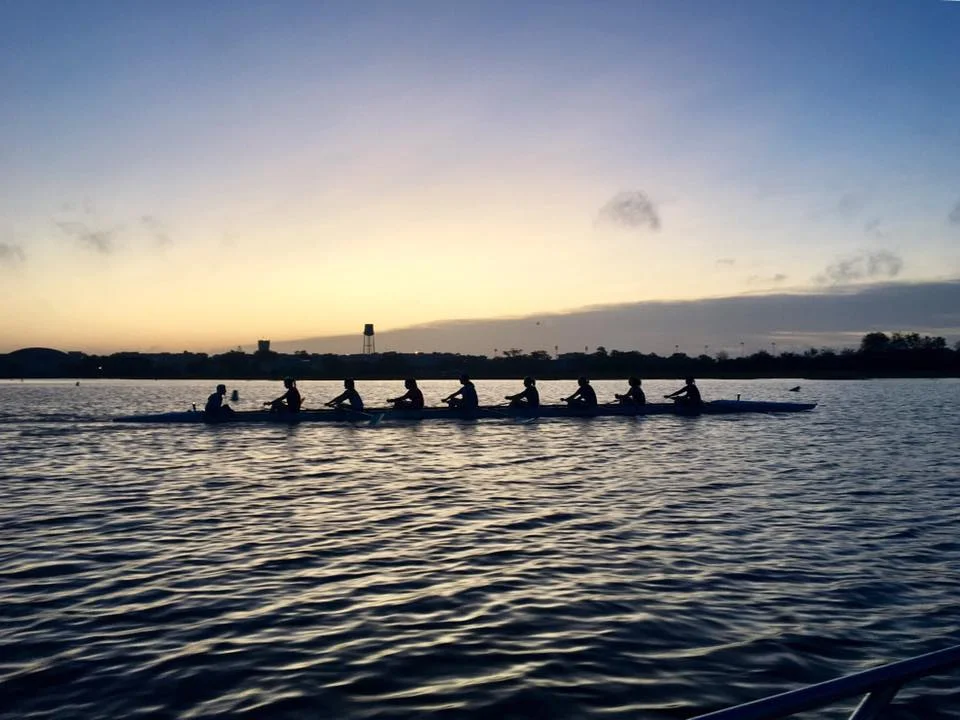
Clemson Sprints Weekend
Coverage and results from the team's trip to Clemson Sprints on Lake Hartwell.
Read More
A non-profit rowing team at the College of Charleston in Charleston, South Carolina.
Dropping an oar in a rowing shell is startling, but it is usually manageable. The boat is moving, the blade may drift toward another crew, and panic can spoil balance. The useful response is to stabilise the boat, communicate clearly, recover the equipment and review what happened.
The priority is safety rather than the oar. Keep the hull level, avoid a collision and prevent anyone from falling into the water. An experienced coxswain should call the next action, while crews without one should use the emergency signals agreed by their coach.
Sweep rowing and sculling create different balance problems. In a sweep boat, one missing handle leaves one side without propulsion. In a scull, a slipping oar can turn the shell more sharply if both rowers react together.
Australian club crews train in changing conditions, from commuter traffic in Sydney Harbour to summer storms on the Brisbane River. Beginners often share the boat with experienced members, so calm calls and a rehearsed recovery routine are more useful than pretending the mishap did not happen.
| Issue | Sweep boat | Scull |
|---|---|---|
| Balance effect | One side loses propulsion and the boat may turn. | A loose oar can pull the shell across the water. |
| First response | Follow the coxswain and keep the other blade clear. | Stop together and identify the loose scull. |
| Main hazard | The handle and shaft can swing into the boat. | The blade can drift into another lane. |
| Recovery | Retrieve it once the coxswain calls the boat steady. | Usually recover it later from a dock or safety launch. |
Call out “oar down” if that is your club’s signal, and stop the stroke at a controlled point. Do not yank the remaining handle trying to imitate two-sided propulsion.
Stay seated and keep your weight centred. Keep both hands off anything that could drag you overboard, and do not lean over the gunwale to grab the shaft. A sudden reach can capsize a light shell.
If the oar is still in its lock, leave it there until the coxswain has checked the boat’s speed and traffic. If it has released, point out its position and let the crew or safety launch handle recovery.
In a sweep boat, the coxswain may ask the rower to feather the remaining oar, hold a steady course or pause near the nearest safe landing. Small corrections are enough; rowing hard with one oar can increase the turn.
In a scull, both rowers should stop together and avoid opposite corrections. The rower nearest the dropped scull identifies it, while the other keeps the bow travelling smoothly. If there is no coxswain, one person should give commands.
Do not jump from the shell, swim after the oar or stand to reach it. A moving hull, cold water and boat traffic make this dangerous. A rower who enters the water can hit the shell or lose orientation in seconds.
Only retrieve equipment when the coxswain or launch confirms it is safe. A seated sweep rower may pick up an oar once the boat is steady, but a scull’s loose blade is usually left for shore or safety-boat recovery.
Sydney Harbour ferry lanes, bridge traffic and a brisk breeze can move a loose blade quickly. On the Brisbane River, summer thunderstorms and humid heat make immediate launch retrieval a poor decision, while strong UV on the Swan River in Perth can turn a long wait into a sun-exposure risk.
After the boat is secure, check whether the drop exposed a setup problem. A coach can verify correct oar length against the rower’s height, reach and boat class, since a poor fit can spoil the catch and make the handle harder to control.
Inspect the handle, shaft, collar and oarlock for looseness, cracks or a bent release fitting. Do not force a tight fitting or alter a release mechanism on the water; the rower should learn the correct adjustment with a coach.
Common causes include a wet or sweaty hand, a cramped grip, an early square or pulling the blade before it is squared. Practising these details in an easy outing reduces the chance that balance, rather than the equipment, caused the slip.
Use this sequence during the incident:
Back on dry land, turn the incident into a useful training note. Carrying oars along Melbourne’s Yarra paths also requires awareness of walkers, cyclists and bridge approaches.
A structured reset is better than immediately repeating full pressure. A coach’s guide to cleaner rowing technique can support a drill that rebuilds grip, balance and timing without turning one mishap into a long absence from the boat.
At Australian regattas, crews commonly travel with boats on trailers, wear club singlets and gather for a barbecue after racing. Those familiar routines help members return to normal training, whether they compete locally or travel interstate.
For a program that welcomes both first-time rowers and experienced athletes, the College of Charleston Crew Team can make the response routine familiar. Everyone then knows what was lost, where it went and who gave each instruction, so the session can continue safely.
College of Charleston Crew fields competitive eights and fours in both Fall head races and Spring sprint regattas across the Southeast.
Learn MoreRecent news, recaps, and announcements from the team.
Coverage and results from the team's trip to Clemson Sprints on Lake Hartwell.
Read More
Spring lineup including Clemson Sprints, SIRA, Dad Vail, and ACRA National Championship.
Read More
Previews and recap of past Head of the Charles appearances, including the 50th annual regatta in 2014.
Read MoreTeam practice, regatta dates, and meetings are listed on the team calendar. Coaches post weekly schedules and travel details for upcoming race weekends.
Charleston Crew / CCAA
PO Box 12941
Charleston, SC 29422
Email: info@cofccrew.org
Phone: 843.513.5900
Phone: 843.276.4241
Interested in joining the team? Fill out the recruitment form and the coaches will follow up.