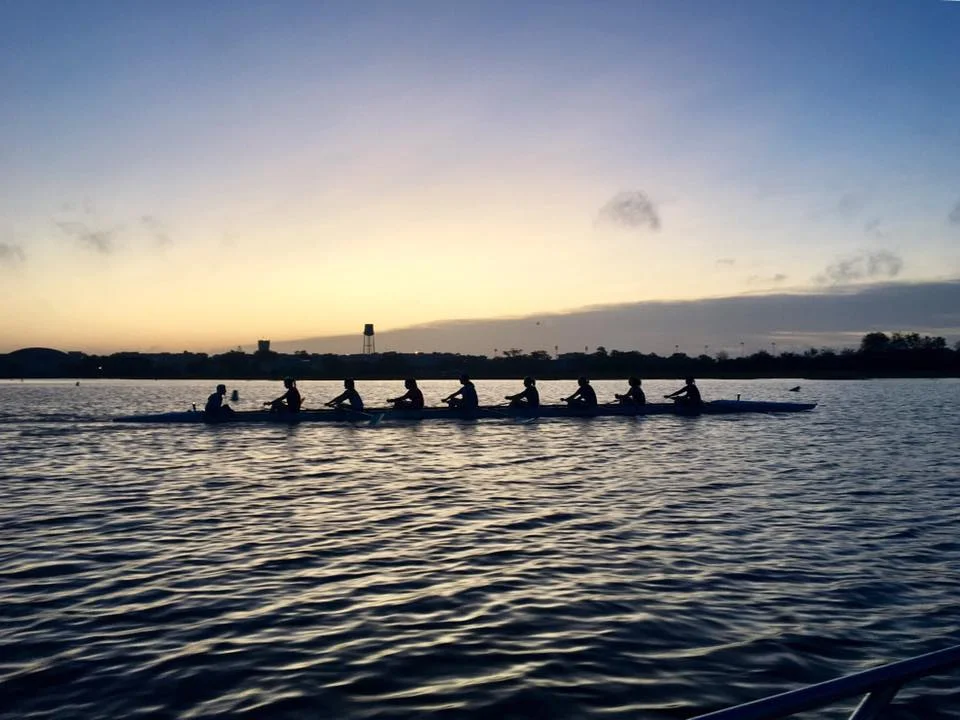
Clemson Sprints Weekend
Coverage and results from the team's trip to Clemson Sprints on Lake Hartwell.
Read More
A non-profit rowing team at the College of Charleston in Charleston, South Carolina.
Rowing can look like an upper-body sport, especially when a crew accelerates past the grandstand and the blades flash together. The visible movement comes from the shoulders, arms and hands, yet the strongest part of each stroke begins lower down. A stable trunk allows the legs and hips to transfer force into the handle without wasted movement.
This matters for Australian rowers training on the Yarra, Swan River or Sydney Harbour, where crews often balance university timetables, early starts and limited access to specialist strength facilities. A well-trained core does not mean chasing six-pack definition. It means controlling posture, resisting unwanted rotation and staying connected from the foot stretcher to the blade.
For beginners, this is encouraging. You do not need enormous biceps to make progress in a boat. College of Charleston Crew welcomes new athletes alongside experienced rowers, and the same principle applies at university clubs across Australia: sound technique and trunk control create a better foundation than simply pulling harder.
At the catch, the rower folds forward from the hips while keeping the spine organised. The abdominals, lower back and hip muscles work together to hold that shape as the legs begin the drive. If the torso collapses, the power generated by the legs leaks away before it reaches the oar.
Core strength also helps maintain a consistent body angle. This is particularly important in sweep rowing, where uneven pressure can twist the trunk and disturb the boat. A controlled midsection lets the rower connect quickly, keeping the blade stable as it enters the water.
The legs produce much of the stroke’s initial force, but the trunk acts as the bridge between the foot stretcher and the handle. Strong abdominal bracing helps the rower open the hips at the right moment, then finish with the arms. This sequence is more efficient than bending the elbows early and trying to muscle the boat along.
A new athlete can learn this connection through regular rowing drills, even before lifting heavy weights. The novice joining guide reflects a useful principle for club rowing: beginners should develop movement quality before worrying about impressive numbers on the ergometer.
When the arms do too much, the elbows bend before the legs and hips have finished their work. The stroke becomes shorter, the handle path loses rhythm and the rower tires quickly. Forearm tension can build as well, which is familiar to anyone who has finished a long session with sore hands and tight wrists.
Australian crews preparing for regattas in Melbourne or Brisbane often train in cool mornings, when stiff muscles can make gripping harder. Sensible hand care supports good technique; these blister prevention tips are relevant for athletes adapting to frequent water sessions and erg work.
Useful core exercises should resemble rowing demands without turning every session into a contest. Dead bugs, side planks, bird dogs and Pallof presses develop control against extension and rotation. Front squats, Romanian deadlifts and split squats add strength through the hips while requiring the trunk to stay steady.
The aim is endurance as much as maximum force. A rower may brace repeatedly over a six-minute race, then complete several pieces during a training session. Two or three short core blocks each week can be more practical than one exhausting workout, especially for students sharing a gym or training before lectures.
Core strength becomes most valuable late in a piece. As breathing becomes harder, the pelvis may tip, the shoulders may round and the drive may lose its sequence. A capable trunk gives the rower a better chance of keeping the chest position and handle speed consistent.
The final part of a race exposes these faults quickly. Understanding the last 500 metres shows why crews need composure and connection when fatigue peaks. The arms still contribute to the finish, but they cannot rescue a stroke that has already lost support through the middle.
A balanced programme gives the core a central role while still developing the arms, shoulders and back. The following comparison shows how each area contributes to boat speed and durability.
| Training focus | Main rowing role | Common problem when undertrained |
|---|---|---|
| Core and trunk | Transfers force and stabilises posture | Collapsing body angle and wasted power |
| Legs and hips | Initiate the drive | Weak acceleration from the catch |
| Back and shoulders | Supports the connection and finish | Poor handle control |
| Arms and forearms | Complete the stroke and control the recovery | Early arm bend or grip fatigue |
| Mobility | Allows efficient positions | Restricted catch or rushed recovery |
For Australian club athletes, strength work should fit the season and water conditions. A crew racing on the Swan River may need to manage wind and chop, while an indoor session during a wet winter morning in Hobart places more emphasis on maintaining consistency away from the boat.
A practical weekly approach can prioritise trunk control without neglecting the rest of the body:
The strongest rowers are not simply those who can pull hardest with their arms. They are athletes who maintain connection from the feet through the trunk and into the blade, stroke after stroke. That foundation supports speed, efficient technique and a more durable training routine, whether the next race is in Charleston or at an Australian university regatta.
College of Charleston Crew fields competitive eights and fours in both Fall head races and Spring sprint regattas across the Southeast.
Learn MoreRecent news, recaps, and announcements from the team.
Coverage and results from the team's trip to Clemson Sprints on Lake Hartwell.
Read More
Spring lineup including Clemson Sprints, SIRA, Dad Vail, and ACRA National Championship.
Read More
Previews and recap of past Head of the Charles appearances, including the 50th annual regatta in 2014.
Read MoreTeam practice, regatta dates, and meetings are listed on the team calendar. Coaches post weekly schedules and travel details for upcoming race weekends.
Charleston Crew / CCAA
PO Box 12941
Charleston, SC 29422
Email: info@cofccrew.org
Phone: 843.513.5900
Phone: 843.276.4241
Interested in joining the team? Fill out the recruitment form and the coaches will follow up.